
Jadual Kandungan

Stop Treating the SDS Like Paperwork
Start here first.
I have watched too many buyers ask for “5 micron, Size #2, standard ring” while leaving out the only facts that actually decide whether the bag survives the line: chemical formula, concentration, operating temperature, solvent content, oxidizer exposure, cleaning cycle, and dwell time, and then they wonder why a neat RFQ turns into swelling media, ugly bypass, short bag life, and a supplier argument nobody enjoys. Why are we still buying a bag before we buy the failure mode?
Here is the hard truth I wish more suppliers said out loud: an SDS is not there to make EHS happy. It is there to stop you from making dumb material decisions.
OSHA’s standardized 16-section SDS format exists for exactly that reason, and Section 10 is not decorative; it must cover reactivity, chemical stability, hazardous reactions, conditions to avoid, incompatible materials, and hazardous decomposition products. OSHA’s Safety Data Sheets brief dan 29 CFR 1910.1200 Appendix D make that plain.
And the compliance pressure is not theoretical. OSHA still lists Hazard Communication, 29 CFR 1910.1200, as the No. 2 most frequently cited standard, which tells me plants are still getting chemical information control wrong in ways inspectors can see from the parking lot. OSHA’s Top 10 cited standards page is worth reading before anyone calls SDS review “admin work.”
Best Filter Bag already has a usable content spine for this topic through penarafan mikron beg penapis, the Panduan pemilihan beg penapis cecair, Beg penapis PTFE untuk bahan kimia agresif, Beg penapis jaring nilon untuk air, cat, dakwat dan resin, Asas rumah penapis beg untuk pembeli industri, dan Sempadan beg penapis RFQ. I would use that cluster because it matches how serious buyers move from definition to material choice to housing fit to purchasing control.
The SDS Sections That Actually Decide Filter Bag Material Selection
Three sections matter.
That is not literally true, because I read the whole SDS, but in real buying work Sections 7, 9, and 10 usually decide whether your first-pass material choice is sane, while Sections 1 and 3 stop you from making the classic mistake of choosing media from a trade name instead of actual chemistry. Isn’t that where most filter bag material selection goes wrong?
A stream described as “acidic cleaner” tells me nothing. A stream identified as 10% HCl at 25°C, or 30% NaOH at 60°C, or a solvent blend containing methylene chloride and toluene, tells me a lot. The SDS is where that ambiguity is supposed to die.
| SDS section | What I pull from it | What it means for filter bag materials | The mistake I see most |
|---|---|---|---|
| Section 1: Identification | Product name, supplier, intended use | Stops trade-name guessing and forces exact material review | Buying from a label instead of chemistry |
| Section 3: Composition / ingredients | CAS numbers, concentration ranges, mixed solvents, additives | Tells you whether the fluid is really one chemical or a cocktail | Treating a blend like a single-compound duty |
| Section 7: Handling and storage | Incompatible materials, storage conditions, moisture or heat sensitivity | Flags chemistry that punishes casual PP or polyester choices | Reading storage notes as “warehouse only” data |
| Section 8: Exposure controls / PPE | Skin, splash, inhalation risk | Raises the cost of bag failure and bag-change mistakes | Ignoring operator exposure during change-outs |
| Section 9: Physical and chemical properties | pH, viscosity, specific gravity, flash point, appearance, temperature behavior | Helps predict flow, blinding, swelling, and pressure-drop behavior | Picking micron before checking viscosity |
| Section 10: Stability and reactivity | Reactivity, hazardous reactions, incompatible materials, decomposition products | This is where bad media assumptions get exposed fast | Treating “chemical resistant” as a complete answer |
| Section 11: Toxicological information | Acute and chronic harm potential | Not a compatibility chart, but a consequence chart | Underestimating how expensive one bad call can get |
I read Section 10 before I trust anybody’s sales sentence. OSHA says that section must define reactivity and incompatibilities; I say that is the section procurement teams skip at their own expense. OSHA’s SDS brief says the quiet part clearly enough.
My Blunt Material Hierarchy for Filter Bag Materials
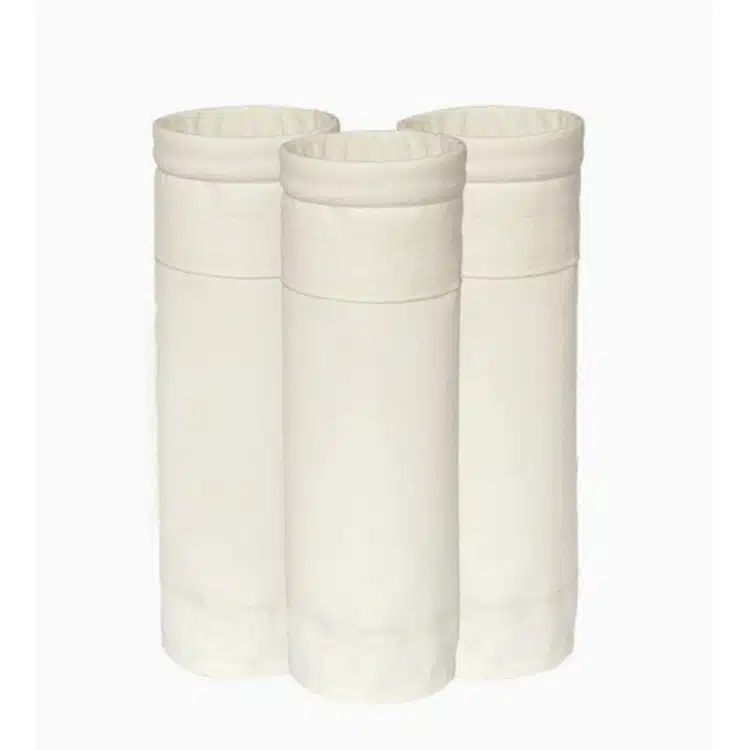
Material decides everything.
Not micron alone, not price alone, and not the phrase “chemical resistant” printed in a catalog, because the same 5 µm bag behaves like a smart buy or a stupid buy depending on whether the fluid is water, caustic, oxidizer, solvent, resin, or hot acidic liquor. Why do buyers still pretend all 5 µm bags live in the same universe?
Polypropylene vs Polyester Filter Bags
I do not trust broad claims here. Polypropylene and polyester get compared as if one is “for chemicals” and the other is “for temperature,” but the real answer depends on the exact chemistry, the concentration, and whether the process is aqueous, solvent-heavy, alkaline, acidic, oxidizing, or cycling hot and cold.
My first-pass rule is simple. Polypropylene often earns the first look in broad aqueous acid and caustic service where the temperature window is honest. Polyester often earns the first look when you need better dimensional stability and higher temperature tolerance than PP, but I get wary fast when strong alkali, hydrolysis risk, or nasty chemistry shows up. That is why I never let “polypropylene vs polyester filter bags” become a two-word debate. It is a chemistry-and-temperature debate.
Beg Penapis Nilon
Nylon still wins.
For water, paint, ink, resin, and broad general liquid duty, nylon is often the economical, honest answer, and your own Beg penapis jaring nilon untuk air, cat, dakwat dan resin page leans into exactly that position instead of pretending every job needs exotic media. Your Beg Penapis Nilon category says the same thing: practical choice, standard housings, repeat replacement logic. That is good positioning because it separates normal service from chemistry theater.
But I would not push nylon into ugly chemistry just because it is cheap. Cheap media gets very expensive when the stream is not mild.
Beg Penapis PTFE
PTFE earns its keep.
When the SDS shows aggressive chemistry, higher heat, low-fiber-shedding requirements, or purity-sensitive duty, PTFE stops looking expensive and starts looking like the adult decision. Your Beg penapis PTFE untuk bahan kimia agresif guide and Beg Penapis PTFE category already position PTFE around acid/alkali service, corrosion-sensitive duty, low fiber shedding, FDA-grade options down to 0.1–100 µm, and even a Beg penapis PTFE 260°C untuk penapisan asid/alkali. That is exactly where PTFE belongs.
And this is where I get opinionated. If the SDS shows a hot, mixed, solvent-rich, oxidizing, or corrosive stream, I would rather have an uncomfortable quote than a comfortable failure.
What Real Incidents Say About Chemical Compatibility Filter Bag Decisions
This part matters.
Buyers love to treat compatibility review as “nice to have” until the line fails, the housing leaks, or somebody gets hurt, and then suddenly everyone becomes very interested in the sentence they skipped in Section 10. Why does industry always find budget for failure, but never enough budget for reading?
The U.S. Chemical Safety Board documented a Tradebe incident where chemical compatibility testing was not performed before a transfer, and the CSB said the failure to confirm chemical compatibility contributed to the explosion. Read that again. Not “might have.” Contributed. CSB Incident Reports, Volume 2 is a better argument for disciplined safety data sheet filter media selection than any marketing deck I have seen.
Another CSB report on Formosa in Baton Rouge said the incident could have been prevented by confirming that the valve’s design temperature was compatible with the process temperature. That is not a filter bag story on the surface, but it is the same engineering sin underneath: people choosing components without matching them to the actual thermal envelope. CSB Incident Reports, Volume 4 should make every buyer more suspicious of vague material claims.
And Reuters reported that two people were killed in the 2021 acetic acid leak at LyondellBasell in La Porte, Texas. I am not claiming a filter bag caused that event. I am saying acid service punishes sloppy compatibility culture wherever it finds it, whether the weak point is piping, valves, seals, or filtration media. Reuters on the LyondellBasell acetic acid leak is the sort of story procurement teams should remember when they argue over a few dollars of media cost.
So no, I do not treat SDS review as box-ticking. I treat it as cheap insurance against dumb confidence.
How I Use SDS to Choose the Best Filter Bag Material for Chemicals
Use this sequence.
I do not start with material, because that is how lazy specs get written; I start with the exact fluid, then I move through concentration, temperature, solids, exposure time, and cleaning chemistry, and only then do I allow polypropylene, polyester, nylon, or PTFE into the conversation. Why choose a bag before you understand the punishment?
Step 1: Identify the exact chemistry, not the plant nickname
“Caustic wash,” “spent acid,” “solvent rinse,” and “CIP return” are not specifications. They are internal slang. Pull the exact ingredients from Section 3, the trade name from Section 1, and the incompatibilities from Section 10.
Step 2: Check the temperature window before the micron rating
I have seen teams obsess over 1 µm versus 5 µm while ignoring that the fluid sits at 85°C during recirculation and spikes higher during cleaning. That is backwards. Temperature can wreck the right micron in the wrong media much faster than particle size ever will.
This is exactly where your Panduan pemilihan beg penapis cecair dan penarafan mikron beg penapis content should carry the reader, because they pull the conversation out of brochure mode and back into solids load, ΔP, and service life.
Step 3: Decide whether you are solving chemistry, solids, or cleanliness
Those are three different jobs. A 25 µm nylon bag in a paint loop, a 5 µm PP bag in a mild aqueous chemical line, and a 1 µm PTFE bag in a high-purity or corrosive duty are not substitutes just because they all fit a Size #2 housing.
Step 4: Use the filter bag chemical resistance chart as the second screen, not the first
The SDS tells you what the fluid is. The chemical resistance chart tells you how candidate media tend to behave against that fluid. That order matters.
If you reverse it, you get nonsense. You start with a media chart, find a “good” cell, and talk yourself into a material before you have checked whether the stream is diluted, hot, oxidizing, mixed with solvent, or cleaned with something nastier than the process fluid itself.
Step 5: Confirm housing fit and ring logic before you send the RFQ
This is the part many blogs leave out. A chemically correct bag can still fail in a bad housing, on a bent basket, or with the wrong ring or seal logic. Your Asas rumah penapis beg untuk pembeli industri page should be in this article because material choice without fit verification is half a decision.
Step 6: Turn the SDS reading into a usable RFQ
I want the RFQ to say what the line is actually doing: chemical formula, concentration, temperature range, flow rate, viscosity, solids profile, target micron, bag size, ring style, housing model, cleaning method, and annual usage. That is why the Sempadan beg penapis RFQ belongs in this cluster. It turns chemistry discipline into purchasing discipline.
Soalan Lazim
What is the fastest way to use an SDS to choose filter bag materials?
The fastest way to use an SDS to choose filter bag materials is to pull the exact chemical identity from Sections 1 and 3, then read Sections 7, 9, and 10 for incompatibilities, temperature behavior, and reactivity, and finally compare those facts against the candidate media’s chemical resistance and operating limits.
That is the shortcut I trust. I do not trust plant nicknames, old POs, or a salesperson saying “this is our standard chemical bag.”
Which SDS sections matter most for filter bag material selection?
The SDS sections that matter most for filter bag material selection are Section 3 for exact composition, Section 7 for handling and storage warnings, Section 9 for physical properties such as pH and viscosity, and Section 10 for reactivity, incompatible materials, and decomposition risk under foreseeable operating conditions.
If Section 10 looks ugly, I slow down. That one section has saved more bad material choices than any “premium” product pitch ever will.
Is polypropylene or polyester the better filter bag material for chemicals?
Polypropylene or polyester can be the better filter bag material for chemicals depending on the exact fluid, concentration, and temperature, because polypropylene often performs well in many aqueous acid and caustic duties while polyester often earns consideration when better heat tolerance and dimensional stability are needed under cleaner, better-defined chemical conditions.
I do not give a one-word answer there. “Chemical service” is too vague to deserve one.
When should I choose PTFE over nylon, polypropylene, or polyester?
PTFE should be chosen over nylon, polypropylene, or polyester when the SDS shows aggressive chemistry, higher operating temperature, solvent exposure, oxidizing conditions, longer dwell time, or a cleanliness-sensitive process where low fiber shedding and wider compatibility matter more than upfront bag cost.
That is usually the point where a cheap bag stops being cheap. I would rather defend a higher quote than defend a bad shutdown.
Can a filter bag chemical resistance chart replace the SDS?
A filter bag chemical resistance chart cannot replace the SDS because the SDS identifies the actual substance, concentration range, hazard profile, and reactivity warnings, while the chart only helps you judge how a candidate media may behave once the exact chemistry and operating envelope are already known.
Use the SDS first. Use the chart second. Reverse that order and you start guessing.
Your Next Step Before You Publish or Quote
Lakukan ini sekarang.
Take one real SDS from your plant, pull out the chemical name, concentration, operating temperature, viscosity, and Section 10 incompatibilities, then write one honest line that says what the bag must survive, not just what micron it should be, and build your buying conversation from there instead of from catalog habit. Why let a vague spec decide your downtime?
If this article is meant to convert serious industrial buyers, I would publish it with the internal links already embedded, then route readers into the Panduan pemilihan beg penapis cecair, the Beg penapis PTFE untuk bahan kimia agresif guide, the Beg penapis jaring nilon untuk air, cat, dakwat dan resin page, Asas rumah penapis beg untuk pembeli industri, dan Sempadan beg penapis RFQ. That path moves the reader from problem awareness to usable specification, which is where B2B SEO finally starts earning its keep.
If you want, I can turn this into a tighter “publishing version” with all ChatGPT citation tags removed and a stronger on-page SEO slug, title tag, and schema FAQ set.


