
Jadual Kandungan
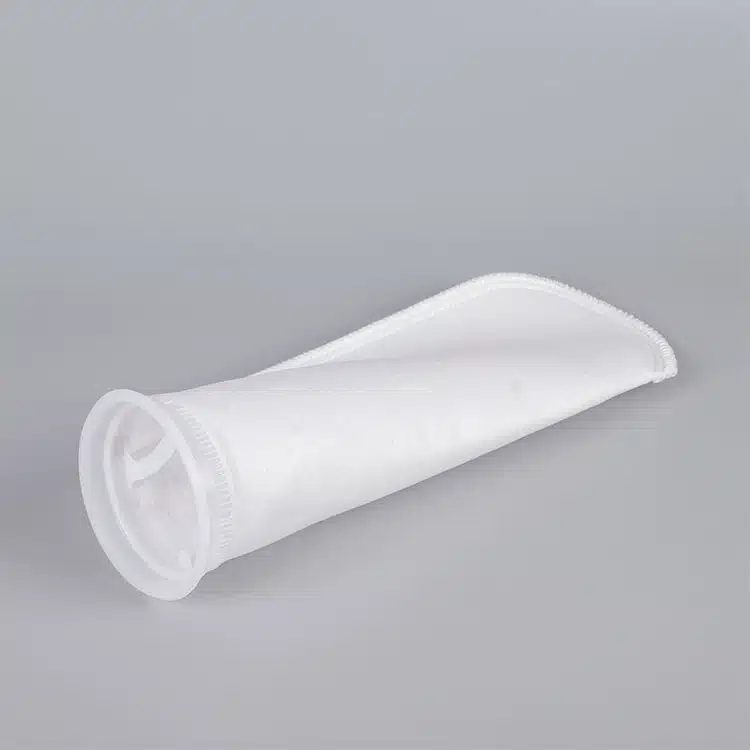
Most solvent bag-filter advice is too polite
Start with chemistry.
I have watched too many buyers ask for “5 µm, Size #2, standard ring” before they can even tell me whether the line is seeing methylene chloride (CH2Cl2), n-hexane (C6H14), toluene (C7H8), acetone (C3H6O), or a mixed wash with carryover that changes every shutdown, and that is how ordinary procurement turns into swollen media, ugly bypass, unstable ΔP, and the familiar argument where everyone blames the bag because it is the cheapest visible part. Why do smart plants still buy solvent filtration like office supplies?
Here is my blunt view: bag filters for solvent filtration are not bought with one answer. They are screened through solvent identity, concentration, operating temperature, viscosity, solids profile, ring construction, housing fit, and how much operator pain the plant is willing to tolerate during change-out.
And yes, regulation has changed the mood. According to the EPA’s methylene chloride risk-management rule, finalized in April 2024, the agency found unreasonable risk across 52 of 53 conditions of use, prohibited most industrial and commercial uses, and imposed workplace protections on the uses that remain. That is not abstract compliance chatter. That is the federal government telling you that solvent decisions now live under a brighter light.
I would build this article around the same internal sequence your site already supports: start with how to use an SDS to choose filter bag materials, move into PTFE vs polypropylene vs polyester filter bags, tighten the capture logic with Apa maksud sebenar penarafan mikron bagi beg penapis, force the hardware conversation through Asas rumah penapis beg untuk pembeli industri, deal with failure through Mengapa beg penapis runtuh dan cara menghalangnya, and close the buying loop with the Sempadan beg penapis RFQ. That is not decorative internal linking. That is buyer intent in the order it actually happens.
The hard filter-media math buyers keep avoiding
Three materials dominate.
But the lazy version of this conversation is “PTFE is premium, polypropylene is cheap, polyester is somewhere in the middle,” which sounds tidy until the solvent blend changes, the startup temperature spikes from 25°C to 60°C, the ring distorts, the bag blinds early, and the so-called cheaper option becomes the expensive one by lunch. Is there anything more expensive than a cheap spec that survives only on paper?
Start with the SDS, not the supplier pitch
I do not trust any solvent filtration spec written before the SDS is opened. OSHA’s Safety Data Sheets guidance dan 29 CFR 1910.1200 Appendix D are plain about what the document must tell you, especially around reactivity, incompatible materials, and decomposition products. And OSHA still lists Hazard Communication, 29 CFR 1910.1200, as the No. 2 most frequently cited standard for FY 2024. That tells me two things. Plants still get chemical communication wrong. And many purchasing teams still treat the SDS like admin work.
That is a mistake.
The fastest useful screen for solvent filtration with bag filters is this: exact solvent or blend, concentration, normal and peak temperature, solids loading, target retention, existing housing size, ring style, and acceptable dirty ΔP. If one of those fields is blank, the material conversation is still half-baked.
My first-pass read on PTFE, polypropylene, polyester, and nylon
I am not offering a compatibility chart here. I am offering the first pass I would use before approving a quote.
| Media | Where I look first | What usually pushes me away | The buying mistake I see most |
|---|---|---|---|
| PTFE | Aggressive solvents, mixed chemistry, low-fiber-shedding duty, hotter service, purity-sensitive lines | Mild duty where the chemistry does not justify the cost | Treating PTFE like a status symbol instead of a chemical decision |
| Polypropylene | Cost-sensitive liquid bag filters in milder chemical service where the SDS and temperature window behave | Solvent-rich duty, higher heat, unstable mixed chemistry | Assuming “chemical resistant” means solvent-proof |
| Polyester | Applications needing better dimensional stability when chemistry allows it | Solvent blends, hydrolysis risk, stronger alkaline attack, messy temperature swings | Buying for temperature alone and ignoring chemistry |
| Nylon | Water, paint, ink, resin, and broad general liquid service | Aggressive solvent duty, strong acids, oxidizers, heat that narrows margin fast | Using a general-service winner in a chemistry fight it was never meant to win |
Here is the hard truth. PTFE (C2F4)n often becomes the adult answer when the solvent stream is ugly enough, hot enough, or clean enough that media shedding and chemical attack stop being side notes. But I have also seen PTFE oversold by suppliers who know the word “fluoropolymer” closes nervous buyers faster than real engineering does.
So no, PTFE is not automatically the best bag filter material for solvents. It is often the least-wrong answer when the solvent system is punishing enough.
What the real world already punished
This part matters.
The filtration industry likes to talk as if chemical compatibility mistakes produce only mild inconvenience, but actual incident records say otherwise, and they say it in a much harsher voice than any sales deck ever will. Why are we still pretending solvent service forgives casual material selection?
In its March 2025 incident report on the Tradebe explosion in Bridgeport, Connecticut, the U.S. Chemical Safety Board documented that chemical compatibility testing was not performed before roughly 4,000 gallons of organic material were transferred into a 10,000-gallon epoxy-lined steel tank; one contractor was seriously injured, and property damage was estimated at about $5.8 million. The CSB did not hedge the point. Failure to confirm chemical compatibility contributed to the incident.
That should make every bag-filter buyer more suspicious.
Then there is La Porte. The CSB’s 2024 LyondellBasell safety video dan Reuters’ reporting on the July 27, 2021 acetic acid release describe an event that killed two contract workers. I am not saying a bag filter caused that release. I am saying solvent and acid service punish loose compatibility culture wherever they find it, whether the weak point is piping, seals, valves, or filtration media.
And for teams who still think hexane is just a routine solvent, the NIOSH IDLH entry for n-hexane puts the immediately dangerous to life or health value at 1,100 ppm, based on 10% of the lower explosive limit. That is why I do not smile when someone says, “It’s only a solvent rinse.”
The material selection guide I would actually use
Use this sequence.
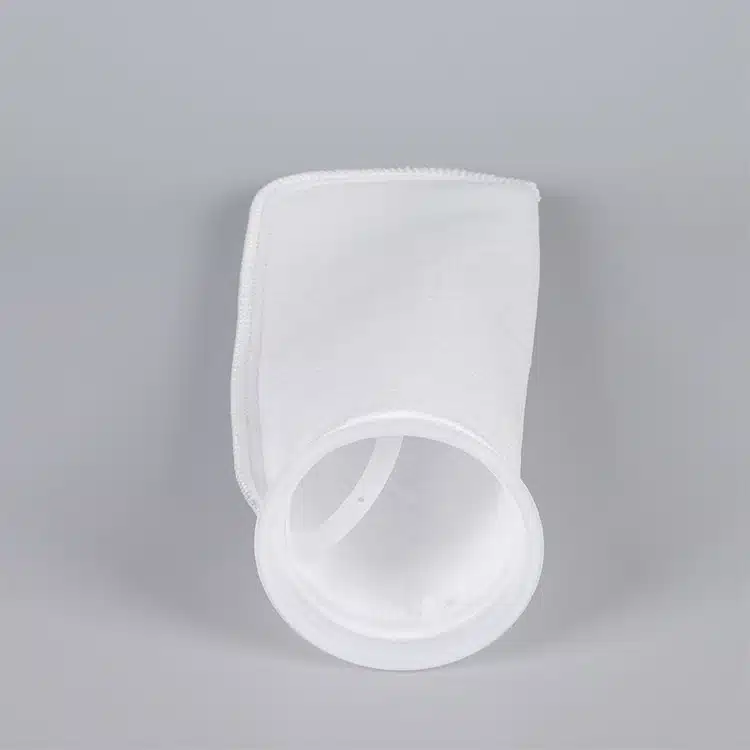
I would never approve bag filter material selection for solvent filtration by starting with micron and ending with price, because that is exactly backwards; I start with what the polymer must survive, then I move to what the bag must capture, then I check whether the housing and ring let the media do its job without folding, bypassing, or getting punished by a mechanical setup that was wrong on day one. Why choose a bag before you understand the punishment?
Step 1: Name the solvent precisely
“Solvent wash” is not a spec. “30% methylene chloride with aromatic carryover at 35°C” is a spec. “Hexane rinse with intermittent resin fines at 25°C” is a spec. “Acetone cleanup loop with 50 µm gummy solids and 5 m³/h flow” is a spec.
Plant nicknames are worthless here.
Step 2: Decide whether the problem is chemistry, solids, or cleanliness
These are not the same job. A bag filter protecting a pump from coarse solids is doing one thing. A bag filter protecting a membrane, nozzle, or filling head is doing another. And a bag filter in a purity-sensitive line where fiber shedding matters is playing a different sport again.
That is why the lazy “best bag filter material for solvents” question annoys me. Best for what?
Step 3: Choose media before you argue about micron
I have seen buyers spend two days debating 1 µm versus 5 µm while ignoring that the chosen media softens in the solvent blend or loses margin during cleaning. Smaller micron numbers do not rescue the wrong polymer. They often just create a more expensive failure.
If your team still treats particle capture as the whole buying job, send them to Apa maksud sebenar penarafan mikron bagi beg penapis. That page should do what too many supplier pages do not: remind buyers that 1 µm, 5 µm, 10 µm, 25 µm, and 50 µm are operating decisions, not prestige levels.
Step 4: Respect the housing
Short sentence. Housing fit wins.
A bag that looks perfect on a datasheet can still lose inside the wrong vessel, because wrong Size #1 versus Size #2 fit, a tired basket, a bad seat, the wrong PP ring versus steel ring choice, or poor venting during startup will make solvent filtration behave like a reliability problem instead of a particle-control step. Do buyers really think the media gets a fair trial inside a crooked system?
This is why Asas rumah penapis beg untuk pembeli industri belongs in the reading sequence, not as a side article. And when failure already showed up in the field, the next click should be Mengapa beg penapis runtuh dan cara menghalangnya, because collapsed bags are rarely a “bad bag” story. More often, they are a system story wearing a consumables mask.
Step 5: Use the material hierarchy honestly
Here is my blunt hierarchy.
If the solvent duty is aggressive, the chemistry is mixed, the temperature is punishing, or cleanliness matters, I look at PTFE first and justify backing away only if the SDS and economics truly allow it. If the service is milder and more stable, polypropylene gets a hearing. If temperature pushes harder but chemistry is still controlled, polyester can earn a look. Nylon stays in its lane for general liquids unless someone can prove, not merely hope, that the solvent exposure is tame enough.
That is why your internal comparison page on PTFE vs polypropylene vs polyester filter bags is the right bridge for mid-funnel readers. It keeps the decision rooted in media behavior, not catalog vanity.
Step 6: Write the RFQ like an engineer, not a shopper
Procurement loves shortcuts. Solvent service hates them.
By the time the quote request goes out, I want the buyer to have declared solvent identity, concentration, normal and peak temperature, viscosity if known, solids description, target micron, nominal versus absolute intent, bag size, ring type, housing model, flow rate, clean ΔP, max allowable ΔP, document requirements, and annual usage. Anything less, and the supplier is being asked to guess.
That is exactly why the Sempadan beg penapis RFQ should sit near the end of this article. Not because it is pretty. Because it turns vague interest into a quote-ready package.
Where I think most solvent bag-filter buyers still fool themselves
They buy adjectives.
They buy “high efficiency,” “chemical resistant,” “industrial grade,” and “premium felt,” then act surprised when none of those words answer whether the media can survive CH2Cl2, tolerate 60°C recirculation, hold shape at the ring, or keep ΔP from going ugly by second shift. Is there a more common B2B sin than buying adjectives and calling it technical selection?
I have one unpopular opinion here. In solvent filtration, under-specifying the media is usually more expensive than over-specifying it once. But over-specifying PTFE into mild duty year after year is still laziness. The right answer is not “buy the toughest thing.” The right answer is “buy the least-wrong thing with evidence.”
And evidence starts with the SDS. That is why how to use an SDS to choose filter bag materials should probably carry more internal authority on your site than half the product pages.

Soalan Lazim
What is the best bag filter material for solvents?
The best bag filter material for solvents is the media whose polymer chemistry, temperature tolerance, seal construction, and cleanliness profile stay stable against the exact solvent blend, concentration, dwell time, and startup cycle shown on the SDS, not the material with the flashiest brochure claim. In nasty solvent duty, that often pushes me toward PTFE, but I never approve that move without checking housing fit and real operating temperature.
How do I choose bag filter media for solvent filtration?
Bag filter media for solvent filtration is chosen by matching the exact solvent chemistry, concentration, operating and peak temperature, solids profile, micron target, ring style, housing geometry, and acceptable pressure-drop window before price is discussed, because media selection is a survival problem first and a purchasing problem second. I start with SDS Sections 3, 7, 9, and 10, then narrow the field between PTFE, polypropylene, polyester, and nylon.
Is PTFE always better than polypropylene or polyester for solvent filtration?
PTFE is not always better than polypropylene or polyester for solvent filtration; it is usually better when the solvent system is more aggressive, hotter, cleaner, or less forgiving, while polypropylene and polyester can still be smarter economic choices when the chemistry window is stable and honestly defined. My problem with this market is not that PTFE gets chosen. It is that PTFE often gets chosen without proving why.
What micron rating should I use in solvent bag filtration?
The right micron rating in solvent bag filtration is the retention level that protects downstream equipment or product quality without creating unnecessary ΔP, short bag life, or blinding, and it must be chosen after chemistry and media survival are settled, not before. For coarse solids capture, 25 µm to 100 µm may be sane. For polishing or membrane protection, 1 µm to 10 µm may be justified.
Why do solvent filter bags fail early?
Early solvent filter bag failure is the loss of useful bag life before the expected change-out interval because the media is chemically attacked, thermally stressed, mechanically unsupported, badly seated, overloaded with solids, or driven into unstable ΔP by a housing and startup routine that never gave it a fair chance. I usually inspect the basket, ring seat, and pressure trend before I accuse the media.
Langkah Anda Selanjutnya
Lakukan ini sekarang.
Take your current solvent filtration spec and rewrite it with the facts buyers usually hide: solvent name, CAS if available, concentration, normal and peak temperature, solids size range, target micron, bag size, ring type, housing model, clean ΔP, dirty ΔP limit, and whether the line cares about cleanliness or only bulk solids removal. Then send that package through your own content chain in this order: SDS review, media comparison, micron logic, housing fit, failure prevention, RFQ.
That sequence is not academic. It is how you stop buying the same mistake twice.
And if I were tightening this page for conversion, I would point serious readers toward how to use an SDS to choose filter bag materials, then PTFE vs polypropylene vs polyester filter bags, then Asas rumah penapis beg untuk pembeli industri, and finally the Sempadan beg penapis RFQ. That is the path I trust because it moves the reader from uncertainty to specification, not from curiosity to another vague quote request.


