
Table of Contents

The dirty truth behind “low extractables”
Three words first.
I have watched too many suppliers pitch pharmaceutical filtration like a branding exercise, even though the real fight starts with polymer chemistry, contact time, solvent exposure, temperature, sterilization method, and the miserable fact that one lazy material choice can push an otherwise clean process into an extractables-and-leachables investigation nobody budgeted for. Why are we still pretending “low extractables” is a marketing adjective instead of a validation problem?
The FDA’s 2025 draft ICH Q3E guidance on extractables and leachables says the quiet part out loud: regulators now expect a holistic, risk-based framework for assessing and controlling extractables and leachables in pharmaceutical products, with patient safety and product quality sitting at the center of the argument. That matters because a filter bag is not outside the system; in a purity-sensitive process, it is part of the system.
And the lab data is not polite either. In the large-scale Analytical Chemistry assessment of 34 single-use bag films, researchers evaluated 34 films spanning eight multilayer film types under worst-case extraction logic, which is exactly the kind of evidence that should make any pharma buyer suspicious of vague “clean media” claims. I do not trust softness here. I trust data, extraction conditions, and documentation.
It gets sharper.
A Journal of Pharmaceutical and Biomedical Analysis study on a model single-use system did not just look at a bag in isolation; it evaluated a system made up of a bioprocess bag, connector tubing, and a hydrophilic disk filter with housing, using water, ethanol, 50:50 ethanol/water, and saline as extraction media, then showed that standard selection can materially change which compounds land above the analytical evaluation threshold. That is the hard truth I wish more pharma-grade filter bag sellers would admit: “low extractables” without method transparency is just polished fog.
Why PTFE keeps showing up in serious pharmaceutical filtration
Short answer first.
PTFE, chemically represented as (C2F4)n, keeps getting specified for pharmaceutical filter bags because the material is non-reactive, chemically stubborn, and better suited than many lower-cost media when the process mixes aggressive chemistry with purity sensitivity, especially where buyers are trying to reduce fiber shedding, surface interaction, and ugly surprises during validation. But should PTFE be the default? I do not think so.
That is where your own site is stronger than most supplier sites. Best Filter Bag already separates the buying logic instead of dumping every medium into one lazy category: the liquid filter bag selection guide pushes readers to think about micron, media, and bag size together; filter bag micron rating explained drags the conversation away from brochure numbers; and PTFE filter bags for corrosive and high-temperature service makes the blunt case that PTFE earns its money when chemistry, temperature, or cleanliness demands get ugly. That structure is not decorative. It is how serious readers move from curiosity to a usable spec.
I would go further. For purchase-ready readers in pharma or electronics, the internal handoff should eventually land on the custom PTFE liquid filter bag for pharma and electronics, because that page already frames PTFE as a purity-sensitive material choice rather than a generic consumable. And yes, I like that. Too many industrial sites still write as if “pharmaceutical filtration” were just water treatment in cleaner clothes. It is not.
The comparison buyers actually need
Most comparison charts are weak.
They obsess over unit price and skip the cost of deviation work, retesting, downtime, and procurement churn, even though those are the bills that actually hurt. So here is the comparison I would hand to any buyer looking for the best filter bag for pharmaceutical filtration.
| Filter bag option | Where I would trust it | Where I get nervous | Extractables risk posture | My blunt take |
|---|---|---|---|---|
| PTFE low extractables filter bag | High-purity liquids, aggressive solvents, acid/alkali duty, pharma and electronics, low-fiber-shedding applications | Overkill in mild service, higher upfront cost, easy to overspec | Usually the strongest candidate when validated correctly | Expensive, yes. Often the least-wrong answer. |
| Polypropylene felt or mesh | Broad chemical service in many industrial liquids, cost-sensitive duty | Validation-heavy pharma lines, heat, purity-sensitive steps, soft documentation from suppliers | Highly dependent on exact formulation and processing | Fine for many plants. Not my first pick for purity bragging rights. |
| Nylon monofilament or felt | General liquid screening, utilities, water-like service, reusable mesh logic | Aggressive chemistry, hotter service, purity-sensitive final protection | Can work upstream, but not where I want to argue with QA later | Honest for general duty. Risky when buyers pretend it is pharma-first. |
| Polyester | Some economical industrial services with reasonable chemistry and temperature | Hydrolysis-prone or chemically harsh wet service | Usually not where I start for low-extractables pharma logic | Cheap mistakes often begin here. |
This table is not anti-nylon or anti-PP. It is anti-self-deception. Your own site already splits nylon toward general-duty liquid service, PTFE toward aggressive chemistry and cleanliness-sensitive duty, and housing-fit pages toward mechanical discipline, which is exactly how the decision should be framed in biopharmaceutical filtration bags and other purity-sensitive lines.
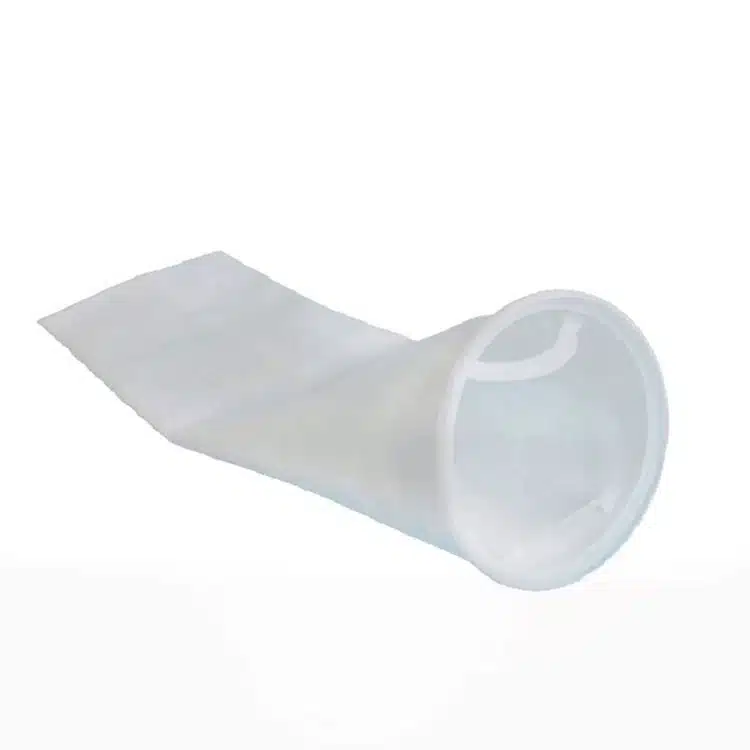
What most buyers miss: the bag is only half the story
This matters now.
I would not approve a low extractables filter bag without forcing the team through bag filter housing basics for industrial buyers, because housing geometry, support basket condition, ring fit, venting, drain logic, and service clearance decide whether a premium media behaves like process control or just an expensive scapegoat. A good PTFE bag in a bad housing is still a bad filtration step.
And when the line starts misbehaving, I would send them straight into why filter bags collapse and how to prevent it. That page gets the ugly part right: collapse is usually a system problem wearing a consumables mask. I agree with that more strongly than most suppliers probably like. If the support basket is bent, the ring is wrong, or differential pressure is drifting without discipline, the media choice becomes the easy target and the wrong diagnosis.
Here is the industry lesson people keep learning the expensive way. In a Reuters report from April 9, 2026, Granules India said it was tightening manufacturing oversight after the FDA flagged issues including record-keeping and contamination control practices. Different component, same pain. In regulated manufacturing, contamination control failures do not stay buried in the plant. They become public, costly, and slow to clean up.
The site path that will actually help this article rank and convert
I spent time on your site.
The strongest internal sequence is not a random stack of product links. I would move readers from the definition problem to the selection problem, then to the housing problem, then to the RFQ problem, because that matches how industrial buyers and pharma engineers actually move when they are serious.
First, use the anchor pharmaceutical filter bag selection guide when readers still need help with micron, media, and bag size. Next, place what filter bag micron rating really means where the article discusses nominal versus absolute logic. Then use PTFE filter bags for corrosive and high-temperature service when the discussion turns to low extractables filter bag options for harder chemistry. After that, route hardware-minded readers into bag filter housing basics for industrial buyers and failure-diagnosis readers into why filter bags collapse and how to prevent it. Finally, close the loop with the filter bag RFQ template for people who are done reading and ready to buy like adults.
That is not “SEO best practice.” That is intent control. And frankly, most B2B sites still mess it up by linking sideways instead of forward.
What I would demand before approving a pharma-grade filter bag
Stop guessing now.
If a supplier wants me to believe their pharmaceutical filter bags are genuinely low-extractables options, I want the extraction conditions, solvent set, contact time, temperature, analytical method, AET logic, sterilization assumptions, batch traceability, media description, ring and seal details, and housing-fit data before anyone says the phrase “pharma-grade” with a straight face. Why should QA buy adjectives?
I would also make the buyer fill out the filter bag RFQ template properly, because a vague request like “5 micron PTFE bag for pharma” is how teams waste a week and still get the wrong quote. Your own RFQ page is right to hammer chemistry, flow, fit, temperature, and documentation. In this sector, blank spaces are where bad purchases hide.
The minimum approval checklist I would use
- Media type and construction, not just “PTFE”
- Micron target in µm, with nominal vs. absolute intent defined
- Bag size, ring style, seal compatibility, and housing model
- Extraction study scope and solvents
- Sterilization assumptions, if any
- Batch traceability and change-control commitment
- Clean and dirty ΔP window
- Intended process step: bulk capture, prefiltration, or final protection
That list is boring. Good. Boring paperwork prevents dramatic deviations.
FAQs
What is a low-extractables filter bag?
A low-extractables filter bag is a filtration bag made from materials and construction methods selected to minimize the release of chemical compounds into process liquids under defined operating and testing conditions, so the bag supports pharmaceutical purity targets without adding avoidable contamination risk during manufacturing, transfer, or holding steps.
I still would not approve one on label language alone. I want extraction conditions, solvents, analytical thresholds, and a clean explanation of what changed between lots.
Why is PTFE often used in pharmaceutical filtration?
PTFE is often used in pharmaceutical filtration because its fluoropolymer structure offers strong chemical resistance, low surface interaction, and a cleaner fit for purity-sensitive applications where aggressive liquids, validation pressure, and contamination-control expectations make lower-spec media more likely to create extractables, shedding, or compatibility headaches during routine processing.
That does not make PTFE universal. It makes PTFE the safer answer when failure costs more than the premium.
How do I choose a low-extractables filter bag for pharma?
Choosing a low-extractables filter bag for pharma means matching the media, micron rating, bag size, ring style, housing fit, extraction-study data, solvent exposure, temperature range, and process purpose to one validated application, so the selected bag protects product quality without creating a hidden documentation or compatibility problem later.
I start with process chemistry and the downstream thing that cannot be allowed to fail. Price comes later.
What documents should a pharma-grade filter bag supplier provide?
A pharma-grade filter bag supplier should provide material identification, extraction-study details, analytical methodology, batch traceability, dimensional and fit data, recommended service envelope, and any agreed quality documents needed for qualification, so the buyer can judge contamination risk, mechanical suitability, and repeatability before the bag reaches production.
If the supplier cannot produce that package quickly, I assume the “pharma-grade” claim is doing more work than the documentation.
Your next move
Do this today.
Take this article live, keep the primary keyword pharmaceutical filtration in the H1, introduction, one H2, and the CTA, and use the internal links above exactly where the reader’s next objection appears, not where the CMS happens to have space. Then push serious buyers from education into the custom PTFE liquid filter bag for pharma and electronics or the filter bag RFQ template, because that is where this content stops being blog furniture and starts behaving like a sales engineer.
My advice is blunt. Do not sell “low extractables” as a soft promise. Sell it as a documented, validated, mechanically honest choice. That is how pharmaceutical filtration pages win the right traffic, qualify skeptical buyers, and avoid the cheap authority-killing mistake of sounding cleaner than they actually are.


