
Table of Contents

Most private-label programs break at the carton
Small mistake.
I have watched private label filter bag programs look technically fine on paper and still blow up in the warehouse, because the media was right, the micron looked right, and the sample passed, yet the carton mark, lot code, and reorder SKU were vague enough that a 5 µm nylon bag got treated as interchangeable with a 5 µm PTFE bag, which is how brands end up eating returns, complaints, and awkward internal meetings that should never have happened. Why do so many teams still call that “operations”?
Private label is not some fringe side business anymore. PLMA’s 2025 U.S. private label report says store-brand sales hit $282.8 billion in 2025 and grew at 3.3%, versus 1.2% for national brands, and Reuters reported in November 2024 that Walmart and Target were stocking more private-label lines as shoppers pushed hard on value. I know those are retail examples, not industrial liquid filtration, but the lesson carries over cleanly: once your name is on the box, packaging and identification stop being clerical work.
And your site is already pointed in the right direction. The OEM and private label filtration program talks about product labels, carton marks, packaging coordination, sampling, and repeat-order consistency, which tells me this H1 should not be treated like a soft branding page; it should work as a control page for buyers who care about repeatability.
Packaging is not cosmetic; it is error prevention
Cartons tell truth.
In private label filter bags, packaging is where the real spec becomes visible to receiving, distributors, warehouse staff, and the buyer who reorders six months later with no memory of the original project, so if the bag itself is precise but the pack hierarchy is muddy, you do not have control at all, you have delayed confusion. Why are people still spending more time on logo size than on pack identity?
The fields I would not let anyone skip
| Packaging level | What I would print | Example |
|---|---|---|
| Unit label | Brand, product family, media, micron, rating type, bag size, ring type, lot/batch, country of origin | BestFilter Pro / PTFE / 5 µm nominal / Size #2 / SS ring / Lot 240326A / Made in China |
| Inner pack | SKU, quantity, lot/batch, PO reference, barcode | SKU: BFB-PTFE-005-NOM-02-SS / Qty 10 / PO 2026-041 |
| Master carton | SKU, gross qty, lot, country of origin, handling marks | 100 pcs / Lot 240326A / Keep Dry / This Side Up |
| Pallet label | Carton count, total qty, pallet ID, destination, shipment ref | Pallet P-07 / 12 cartons / 1,200 pcs / Los Angeles DC |
But the compliance piece is where a lot of private label programs get sloppy. CBP’s country-of-origin marking guidance says every article of foreign origin entering the United States must be marked legibly with the English name of the country of origin unless an exception applies, and the FTC’s Made in USA guidance says an unqualified “Made in USA” claim has to meet the “all or virtually all” standard. So no, you do not get to hide behind a patriotic design and hope no one notices where the bag was actually made.
My view is blunt. A private label filter bag carton should answer four questions in under five seconds: what it is, what it fits, what batch it came from, and whether it can legally be described the way marketing wants to describe it.
Labeling is process control wearing a sticker
Bad label.
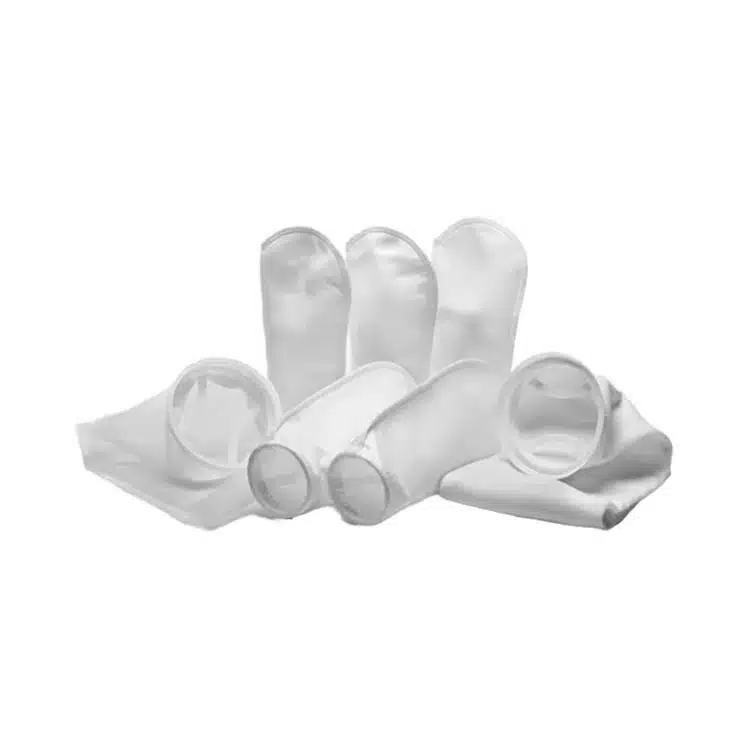
I do not trust any filter bag label that says only “5 micron” and stops there, because a serious buyer needs to know whether that means nylon or PTFE, nominal or tighter retention intent, Size #1 or Size #2, PP ring or steel ring, general water duty or corrosive chemical duty, and whether the bag is being sold as the same item across samples, first PO, and repeat supply. Why are sellers still acting as if one number is a specification?
That is exactly why this H1 should hand readers into the right internal pages. Your liquid filter bag selection guide does the right thing by tying micron, material, and bag size together; your page on micron rating for filter bags keeps buyers from confusing a particle target with the whole spec; your bag size standards guide puts real dimensions behind #1, #2, 01, and 02; and your bag filter housing basics reconnect the bag to the vessel, support basket, and change-out reality. That is the difference between content that ranks and content that actually pre-qualifies a buyer.
I would also stop treating barcode logic as “for later.” GS1’s GTIN standard exists so trade items can be uniquely identified when they are priced, ordered, or invoiced, and that matters the moment one custom filter bag exists in plain pack, branded pack, distributor pack, and export pack. Those are not the same commercial item, even if the felt and stitching started from the same production line.
Here is the hard truth I have learned. Label content should follow failure risk, not brochure aesthetics. If the line runs HCl, NaOH, IPA, hot resin, or cleanliness-sensitive liquid, I want the label to help the next human avoid a bad substitution, not just admire the branding.
SKU control is where margin is protected
Names are cheap.
I have seen buyers invent SKU systems that look tidy in a spreadsheet and fall apart the first time they add one export market, one alternate ring, one tighter micron version, and one branded carton revision, which is why I no longer believe vague item names are harmless; they are an invitation to silent substitution, slow quoting, and the kind of reorder error that makes everybody claim the supplier “must have changed something.” Why give confusion a purchase order number?
A SKU schema I would actually approve
I would build the SKU around the attributes that change failure risk:
BFB-PTFE-005-NOM-02-SS-CN
Where:
BFB= brand or program codePTFE= media005= 5 µmNOM= nominal retention class02= Size #2SS= stainless steel ringCN= country-of-origin code for commercial handling, not as a replacement for legal marking
That is boring on purpose. Boring scales.
And this is not just paperwork theory. NIST’s 2024 manufacturing economy report points to downtime at 8.3% of planned production time and about $245 billion for U.S. discrete manufacturing, while GAO’s Kauffman and Associates decision explains how latent ambiguity in an RFQ has to be clarified, and GAO’s Guidehouse decision shows how a quotation can die simply because it never reached the designated inbox in the required way. Different market. Same adult lesson. Ambiguity and sloppy control do not stay administrative for long; they become cost.
That is why this article should push serious readers into your filter bag RFQ template. Packaging fields, label fields, and quotation fields are not separate disciplines in private label filtration. They are one control system wearing different clothes.
FAQs
What are private label filter bags?
Private label filter bags are filtration bags manufactured by one supplier and sold under another company’s brand, with agreed control over media, micron rating, size, packaging, label content, and repeat-order identification so the buyer can sell a branded product without running its own factory.
I would add one warning. If the supplier controls the build but the buyer does not control the naming, labeling, and pack architecture, the brand is only cosmetic. The supplier still owns the operational truth.
What should appear on a private label filter bag label?
A private label filter bag label should identify the brand, product type, filter media, micron value, retention description, bag size, ring style, batch or lot code, quantity, and country of origin, and it should do so consistently across the unit label, carton label, packing list, and reorder system.
I do not like minimalist labels in industrial filtration. They look clean and behave badly. A label should help receiving, maintenance, purchasing, and the next distributor avoid a wrong substitution.
How do I build SKU control for custom filter bags?
SKU control for custom filter bags means creating one stable item code that reflects the attributes buyers actually reorder against, usually media, micron, rating class, bag size, ring type, and commercial pack version, while separating artwork revisions and lot codes so one change does not quietly create a different product.
My rule is simple: if a change affects fit, chemistry resistance, retention behavior, or commercial handling, it deserves a controlled identifier. If it does not, do not multiply SKUs just to feel organized.
Do private label filter bags need country-of-origin marking?
Private label filter bags imported into the United States generally need country-of-origin marking because CBP requires foreign-origin articles to be marked legibly with the English name of the origin country unless a specific exception applies, and origin claims on labels or packaging must also avoid misleading “Made in USA” implications.
This is where people get lazy. A U.S. address, a U.S. flag, or a proud-sounding brand name does not magically fix origin compliance. The legal words still matter.
What is the difference between OEM filter bags and private label filter bags?
OEM filter bags are usually built to another company’s technical requirement or integrated into that company’s product line, while private label filter bags are sold under the buyer’s own brand and therefore demand tighter control over packaging presentation, label language, carton marks, and repeat-order consistency.
In real projects, the line between them gets blurry fast. I do not care what the sales team calls it. If your brand is on the carton, act like a brand owner.
Your Next Move
Be blunt.
If you want to sell private label filter bags without creating a reorder mess, stop approving artwork before you approve data, and stop talking about branding before you lock the control fields that brand will ride on for the next 12 months. Why build a polished box around a weak SKU?
I would send one approval sheet that includes media, micron and rating type, bag size, ring style, chemistry, operating temperature, pack quantity, required label fields, lot-code format, country-of-origin language, and annual demand by SKU family. Then I would force that sheet to match the carton, the purchase order, the ERP item master, and the supplier quote. If any one of those four says something different, the program is not ready.
That is the hard truth. In private label filtration, the brand is not the logo. The brand is the discipline.


